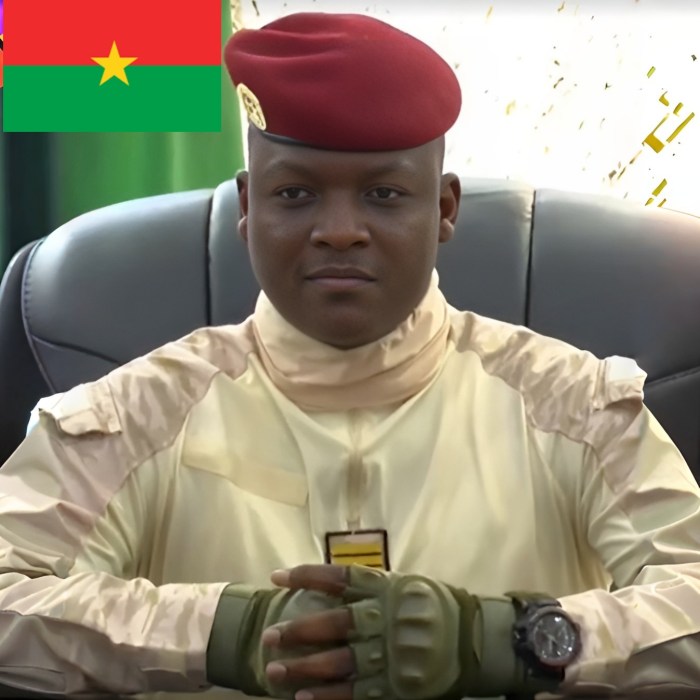
Ibrahim Traoré was born on March 14, 1988, in Bondokuy, Burkina Faso. He studied at the University of Ouagadougou and later joined the military. Traoré rose to prominence as a key figure in the January 2022 coup that ousted President Roch Kaboré. He became the president of Burkina Faso in September 2022 after another coup.
Since assuming power in September 2022, President Ibrahim Traoré has initiated a series of significant reforms and projects across various sectors in Burkina Faso. These developments reflect his administration’s focus on national sovereignty, economic revitalization, and social infrastructure.
1. Economic and Industrial Reforms
President Traoré has prioritized economic sovereignty by enhancing local industries. In 2023, a state-of-the-art gold mine was inaugurated to strengthen local gold processing and increase value addition. Additionally, the government halted the export of unrefined gold to Europe, ensuring that profits and resources remain within the country. Efforts to boost the cotton industry included constructing a second cotton processing plant and launching the National Support Center for Artisanal Cotton Processing, thereby empowering local cotton farmers.
2. Agricultural Development
To bolster food security and reduce reliance on imports, the administration distributed over 400 tractors, 239 tillers, 710 motor pumps, and 714 motorcycles to support rural agriculture. These initiatives led to increased agricultural output: tomato production rose from 315,000 metric tonnes in 2022 to 360,000 metric tonnes in 2024; millet production increased from 907,000 to 1.1 million metric tonnes; and rice production grew from 280,000 to 326,000 metric tonnes over the same period.
3. Infrastructure and Housing
The government has embarked on infrastructure projects, including upgrading roads and constructing new ones to enhance connectivity. A notable initiative is the construction of the Ouagadougou-Donsin Airport, set to open in 2025 with the capacity to handle 1 million passengers annually. In addressing housing shortages, especially for internally displaced persons, the administration launched the construction of 1,000 social housing units across various regions, aiming to ensure adequate housing for all citizens by 2030.
4. Energy and Electrification
Aiming to bridge the urban-rural divide, the government adopted a decree to implement an ambitious rural electrification strategy. This initiative targets achieving a rural electrification rate of 50% by 2028, thereby promoting economic and social development in underserved areas.
5. Governance and Anti-Corruption
President Traoré’s administration has taken steps to enhance governance and combat corruption. Audits were launched to examine public accounts, leading to the identification of embezzlement and the sanctioning of several high-ranking officials. These measures aim to restore public trust and ensure transparent management of public resources.
6. Cultural and Judicial Reforms
In a move to reinforce national identity and reduce colonial influence, the government mandated that magistrates and other judicial officials replace traditional French-style black robes with attire made from local cotton fabric, known as faso dan fani. This change symbolizes a broader effort to promote cultural sovereignty.
7. Legal and Social Policies
The administration has proposed reinstating the death penalty, which was abolished in 2018, as part of broader legal reforms. Additionally, a draft law to criminalize homosexuality has been adopted, aligning Burkina Faso with other countries in the region that have enacted similar legislation.
8. Military and Security Measures
To address internal security challenges, President Traoré has restructured the military, including the dismissal of officers accused of misconduct. The government has also established a special rapid intervention brigade to combat insurgency and maintain order, contributing to the return of over 343,000 internally displaced persons to their homes.
9. Fiscal Policies
In an effort to prioritize public needs, the president directed government ministries to reduce expenditures, reallocating savings toward essential services such as clean drinking water and food security. This directive underscores the administration’s commitment to addressing basic needs and improving citizens’ quality of life.
10. Political Developments
In December 2024, President Traoré dissolved the existing government and appointed Rimtalba Jean Emmanuel Ouedraogo as the new prime minister. This restructuring aims to align the government’s composition with the administration’s vision of enhancing national sovereignty and promoting development.
These initiatives collectively reflect President Traoré’s approach to governance, emphasizing national sovereignty, economic self-reliance, and social development.
Traoré’s leadership style is marked by a strong focus on security and fighting terrorism. He has been vocal about the need for Burkinabés to take control of their own security and has sought support from Russia’s Wagner Group.
Some people criticize his methods, while others see him as a strong leader who is willing to take tough decisions to protect his country. The criticism includes concerns about authoritarian tendencies and human rights issues.
Human rights issues surrounding Ibrahim Traoré’s leadership in Burkina Faso are multifaceted. Some concerns include ¹ ²:
- Restrictions on Freedom of Expression: Traoré’s government has shut down French media outlets, accusing them of biased reporting and propaganda undermining his government. This move has sparked debates about press freedom and government control over media narratives.
- Security Measures and Human Rights: Traoré’s administration has implemented rapid response protocols to counter security threats, which some see as effective measures to address complex security challenges. However, others criticize his methods, citing potential human rights implications.
- Economic Inequality and Poverty: Traoré has spoken out about growing inequality and poverty in Burkina Faso, particularly in rural areas where women suffer the most. He emphasizes the need for collective effort to ensure every citizen has access to basic services like education, healthcare, and employment opportunities.
- Authoritarian Tendencies: Some critics view Traoré’s leadership style as authoritarian, given his military background and decisions like expelling French troops and seeking alliances with Russia. Others see him as a strong leader willing to take tough decisions to protect his country.
It’s essential to consider multiple perspectives when evaluating Traoré’s leadership and its impact on human rights in Burkina Faso.
Burkina Faso gained independence from France on August 5, 1965, as the Republic of Upper Volta. The country’s early years were marked by political instability, with multiple coups and regime changes.
In the early 1980s, Thomas Sankara, a charismatic military officer, rose to prominence. Sankara’s presidency, which began in 1983, was marked by significant reforms aimed at self-sufficiency and social change. He implemented vaccination campaigns, increased access to education, and promoted women’s rights. Sankara also emphasized environmental protection, launching a nationwide reforestation effort and promoting sustainable agriculture.
Sankara’s policies were often radical and anti-imperialist, earning him international attention and admiration. However, his presidency was cut short when he was overthrown and assassinated in 1987 by Blaise Compaoré, who would rule the country for the next 27 years.
Compaoré’s regime was marked by authoritarianism and human rights abuses. He was eventually ousted in 2014, and a transitional government took power. In 2015, Roch Marc Christian Kaboré was elected president, but his government struggled to address the growing threat of jihadist groups in the region.
In January 2022, Paul-Henri Sandaogo Damiba led a military coup, ousting Kaboré. Damiba’s government also faced criticism for its handling of the security situation. In September 2022, Captain Ibrahim Traoré seized power from Damiba, citing the need for more effective action against jihadist groups. Traoré has vowed to prioritize security and stability, but the country remains a challenging environment.
Throughout its history, Burkina Faso has faced significant development challenges, including poverty, lack of infrastructure, and security threats. The country’s trajectory has been shaped by both internal dynamics and external influences.
The situation in northern West Africa is complex, and pinpointing specific sponsors of jihadist groups can be challenging. Various groups have been active in the region, including Ansarul Islam, Jama’at Nasr al-Islam wal Muslimin (JNIM), and the Islamic State in the Greater Sahara (ISGS). These groups often have diverse funding sources, including:
- Local grievances and extremist ideologies
- External support from other extremist organizations
- Potential state or non-state sponsors
Some alleged sponsors and supporters include:
- Other extremist groups in the Sahel region
- International terrorist networks
- Potential state sponsors (though evidence is often limited)
The motivations behind these sponsorships can vary, including:
- Spreading extremist ideologies
- Exploiting local grievances and instability
- Pursuing regional or global agendas
The situation is dynamic, and addressing these challenges requires a comprehensive approach that includes security, development, and diplomacy.
Burkina Faso has several natural resources that could be of interest to external actors, including:
- Gold: Burkina Faso is a significant gold producer in West Africa, with many operating mines.
- Manganese: The country has manganese deposits, which are used in steel production.
- Other minerals: Burkina Faso also has deposits of copper, zinc, and phosphate.
These resources could potentially contribute to the country’s economic development. However, the exploitation of natural resources can also be a factor in conflict and instability, particularly if governance and transparency are lacking.
 An Investment in Education