30th January 2025
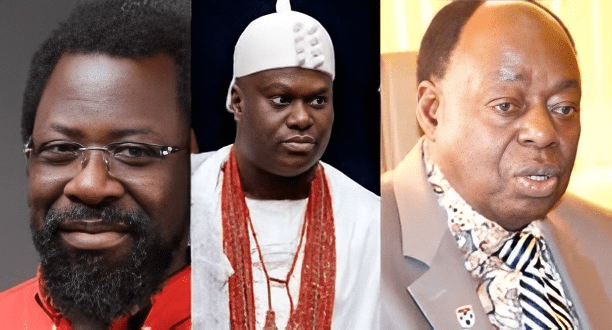
The case between Dele Farotimi and Afe Babalola reached a critical point when it was reported early on Monday morning that the Ooni of Ife, Oba Adeyeye Ogunwusi, had intervened.
Media coverage suggested that the traditional ruler, along with a group of elders, met with Babalola the previous night. Despite multiple reports, no journalist appeared to have witnessed the meeting firsthand; rather, they relied on secondhand accounts. As a result, the same narrative circulated almost verbatim across various media outlets without any inquiries into pertinent questions, such as the instigator of the reconciliation meeting or the conspicuous absence of Farotimi, the case’s central figure.
While we recognize the Ooni’s role as a peacemaker, the challenge of using a traditional-style resolution for issues related to the integrity of contemporary institutions lies in merely postponing underlying crises, which ultimately undermines opportunities to reinforce the pivotal forces that govern our lives.
The Ooni’s intervention holds significant resonance within the context of our society’s traditions, where the masquerade is viewed as an integral part of judicial institutions, and its mystique must be preserved. Publicly de-robed, a masquerade is swiftly surrounded by fellow masked spirits to shield its nakedness from prying eyes, thereby upholding the moral universe of the community that regards the masked figure as the spirit of their deceased ancestor. By stepping in, the Ooni similarly employed his moral authority to restore dignity to a venerable man, a legal institution in himself, who had engaged in a demystifying struggle and required this face-saving closure. This resolution might have sufficed if the matter had merely involved a power struggle between two primary actors. However, a closer examination reveals that Babalola was not the only egungun in this context; his co-accused, the Supreme Court, also plays a role. By failing to address serious allegations against the judiciary, the institution remains vulnerable to widespread public skepticism.
Are there ethical principles, values, and legitimacies inherent in our traditional institutions that could similarly rectify the Supreme Court’s demystification? The simplest response is to assert that the Ooni’s moral jurisdiction does not extend to these modern institutions, suggesting it should not be his obligation to restore the image of an entity that has repeatedly fallen into disrepute. Nonetheless, the inquiry persists: what remains of the Supreme Court’s authority that qualifies it to administer justice for the populace? Some have characterized the resolution as “the best of Yoruba jurisprudence,” highlighting how readily our people exalt native resolutions when faced with the principles of modern society. This issue transcends a mere clash between an elder and a recalcitrant younger person deserving of “forgiveness”; it pertains to justice as vital for the survival of Nigeria.
Babalola asserted that Farotimi also “attacked” Supreme Court justices, yet this assertion is flawed. The Supreme Court’s gradual self-demystification has been unfolding for years, manifesting through numerous election petitions. One of my frustrations with this case has been how the media simplified it to a conflict between two individuals, blinding many commentators who reduced the issue to either their indignation over disrespecting an elder or minute legalities.
If the goal were to uncover the truth regarding the contested case, it should have been civil rather than criminal. Farotimi would not face imprisonment at Babalola’s behest; rather, he would have been afforded the opportunity to summon the Supreme Court justices he accused of complicity, compelling them to clarify how “10” could translate to “254.”
If allowed to advance reasonably, this case could have been one of the most compelling in our society’s history, compelling judges to evaluate themselves. This would have served as a litmus test of their character and capacity to redeem an institution increasingly seen as a parody. Unfortunately, what emerged was a climate where, if Nigeria were a society valuing truth, commentators would not be idly querying, “Can he prove his accusations?” They would instead actively pursue the truth.
Regrettably, our collective ethical framework has become so fragmented that allegations of Supreme Court corruption did not provoke an urgent quest for truth. The situation became so dire that television anchors delivering their opinions amid the case’s development lacked the curiosity to obtain the disputed court judgment for informed analysis. Their best attempt at public engagement involved inviting various lawyers to rehash stale opinions about legal technicalities.
Gratitude is owed to Dr. Opeyemi Banwo, who undertook the initiative to locate and analyze the original copy of the case, demonstrating that Farotimi raised valid concerns. Those who have not examined his article titled, The ‘10-Hectare-for-254-Hectare Mistake’ That Sparked the Mother of All Defamation Wars Between Dele Farotimi and Chief Afe Babalola are encouraged to do so.
In a society that takes itself seriously, the judges involved in this case would not only be called to account for their altered judgment but also face intense scrutiny. Each prior case they adjudicated would be re-assessed in light of the accusation that what they amended may extend beyond a mere clerical mistake. Genuine journalists would investigate their reliance on the “slip rule correction” and critically analyze our judiciary system.
Yet again, what emerged was a scenario where an individual in Nigeria could initiate a criminal case against another and subsequently announce its withdrawal, reinforcing Farotimi’s assertion that certain individuals wield excessive power, which enables them to exploit public institutions.
Babalola’s satisfaction was insufficient; he further intensified the drama by naming the influential figures whose earlier appeals he had declined. His prowess as a successful lawyer was evident in his grasp of the importance of theatricality. He regaled the audience with anecdotes of his virtues, such as rejecting an oil block offer on the premise that “the money was too much” and he was already burdened by his existing wealth. It is noteworthy that his rejection was not due to a moral objection towards the offer. A mention of the individual who extended that oil block offer would have added depth to his narrative.
In any case, after enriching the discourse with narratives of Yoruba history and honoring tradition, he ultimately capitulated just as the moment reached its zenith. The entire matter concluded there, including the troubling complicity of the police, who feigned a lack of interest in the case beyond serving the interests of the affluent. In the hands of a skilled dramatist like Ola Rotimi, this entire affair might have been transformed into a poignant satire.
 An Investment in Education